How do I prevent head lice?
Just when you’ve finally gotten your child lice-free after weeks of treating with lice shampoo and the nit comb, you discover that your child has head lice again.
Nowadays, it’s not a question of whether they will get head lice, but when.
Eagerly, parents follow advice from other parents that seems to have worked for them, but unfortunately, that doesn’t work either.
Here you’ll find reliable information from professional head lice specialists about what does work, what doesn’t, and – to remove all doubt caused by contradictory reports – also why it does or doesn’t work.
For those who take our word for it and to get straight to the point: there is absolutely nothing you can put in the hair that will make lice skip your child. Even persistent urban legends like tea tree oil: not true.
It’s simply impossible to prevent a louse from climbing into your child’s hair.
But what you can control is making sure that the one louse doesn’t get the chance to develop into a full-blown infestation: weekly combing.
And no, this doesn’t need to take an hour. It can even be done in just 10 minutes using a unique Comb Screening Methode, which allows head lice to be easily and permanently kept at bay. That is significantly less work than treating your child for weeks and constantly worrying about reinfestation.
For those who don’t just take this at face value, we explain everything below.
Head lice at school
At some point, you’ll wonder if it’s even worth it to keep treating your kids. How do you prevent it when it’s always present at school, when her best friend chronically has head lice, and your child’s hair seems like a magnet for lice?
On the other hand, doing nothing, and within 2 months seeing your daughter’s hair start to take on a life of its own, your son’s hair looking like a zoo, until the school informs you that they can’t return until lice-free, is not an option.
But applying lice treatments almost every week – killing mainly adult lice while some eggs survive – is also not an option for the health of your child’s hair and scalp, nor for your wallet.
Why is it so prevalent at school, while previous generations barely suffered from head lice?
First, back then head lice had just suffered their biggest defeat with the use of DDT during the war. A super effective treatment, if only it hadn’t proved so harmful to humans that it was taken off the market.
In the decades after, there were very few head lice left.
Modern lice treatments, mainly based on permethrin or dimethicone, are effective against lice, but, despite the promises, are poor at killing eggs.
Most people don’t know this, think their child is lice-free after treatment and a single combing, and unknowingly send their child back to school with live eggs, where the infestation can continue.
Additionally, most schools look for head lice using outdated methods and insufficient knowledge to identify all infestations.
On average, only 10% of head lice infestations are detected at school… 90% go unnoticed!
Children who no longer have an active infestation – only dead eggs left from previous infestations – are often incorrectly labeled as infested.
The first step parents can take for prevention is to address the biggest source and notify schools with outdated lice protocols about an alternative approach that can make schools almost entirely lice-free.
Also, always notify school, family and friends so they too can screen and treat their kids so they can not re-infestate your child.
Transmission
How does a louse actually get into the hair? More information can be found in our blog Transmission.
In short: lice don’t have walking legs, but climbing legs. Lice climb very quickly and skillfully from hair to hair but are completely immobile on regular surfaces. A louse can only enter a head via hair-to-hair contact.
This can be direct hair-to-hair contact when heads are close enough, or indirect hair-to-hair contact via objects where hair has been, such as hairbrushes or hair ties.
Many think intensive hugging is required, but a louse only needs a few seconds to cross. On average, there are five to ten brief, unnoticed contact moments per day, such as a quick kiss on the cheek, playing together, wrestling, or watching a screen together. It is therefore pointless to ask children to stay away from others; this is simply impossible to enforce.
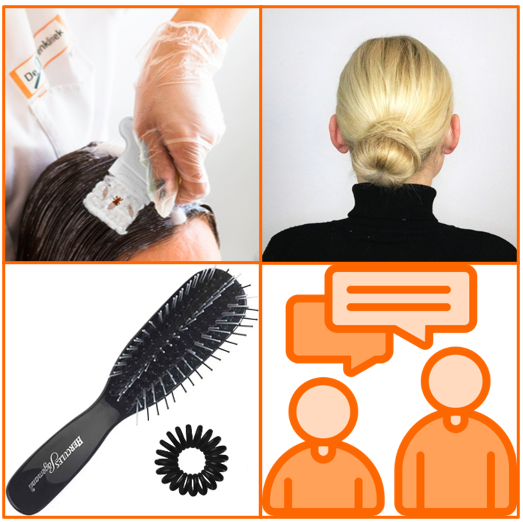
What does help is keeping long hair tied close to the head using a bun. Loose hair, braids, or ponytails touch other children’s hair more easily.
It’s also advisable to use hairbrushes and elastics made from a single piece of plastic, such as Invisibobbles and the Hercules Painfree Scalp Brush. As long as you remove the hair after use, there are no folds or gaps where lice can remain.
Preventive products
Now we come to a topic that is surrounded by many persistent myths.
Many people are firmly convinced of the preventive effect of certain products. When a child, after using such a product, simply has not come into contact with an infested child, this good fortune is attributed to the product, whereas in reality it had no preventive effect whatsoever. There is not a single study, nor any scientific evidence, demonstrating that essential oils or other commercial sprays can actually prevent head lice.
It can even be counterproductive, as the false sense of security may lead parents to check their child less frequently.
Here’s an overview of the different types (commercial and home) products that claim preventive effects:
- Lubricants or smoothing products (oil, silicone, hair serums)
• Intended mechanism: Hair becomes slippery or sticky, making it difficult for lice to grip or move.
• Why it doesn’t work: Lice have highly specialized claws that fully grasp a hair, and the hair scales actually provide traction. Lubricants may slow movement temporarily but do not prevent it. - “Insecticide-like” sprays (low concentration synthetic chemicals, some herbal extracts)
• Intended mechanism: Kill or repel lice on contact.
• Why it doesn’t work: The concentration in commercial preventive products is too low to kill lice effectively. Furthermore, lice must actually come into contact with the substance; merely being present on the hair is not enough. - Physical barrier claims (hairspray, powder, cream forming a “layer”)
• Intended mechanism: A layer over the hair supposedly prevents a louse from attaching.
• Why it doesn’t work: The physical characteristics of lice (small size, claws that fully grasp a hair) make this mechanism irrelevant. Lice can move along or between a coating. - Scent or essential oils (tea tree, lavender, eucalyptus, mint, anise, etc.)
• Intended mechanism: The scent would repel lice like a natural “insect repellent.”
• Why it doesn’t work: Lice select hosts based on warmth, humidity, and CO₂, not hair or sweat odor. Strong scents may sometimes trigger a brief avoidance reaction under lab conditions, e.g., in a Petri dish, where high concentrations are applied directly. In practice on the scalp, the products are diluted, contact with all lice is minimal, and most essential oils evaporate within a few hours, often within 1–2 hours at room and body temperature. This makes contact time too short to be effective.
• Safety aspects: The National Center for Complementary and Integrative Health (NCCIH) notes skin irritation and allergic reactions as known side effects, especially when applied undiluted. Repeated use of tea tree oil (sometimes with lavender oil) in young boys has been associated with temporary breast growth (gynecomastia), attributed to possible hormonal activity of compounds in these oils that disrupt normal endocrine balance. Although not everyone will experience hormonal imbalance, the oils contain biologically active substances that may affect hormonal systems, warranting caution with frequent use, especially in children. - Combinations of the above products
• Sometimes oils and lubricants are combined, claiming multiple barriers.
• Why it doesn’t work: Combining them changes nothing; lice still grip hair, and scent is not a factor in their choice of host.
Hygiene
“Lice don’t like clean hair” or the opposite “lice only come to dirty people.”
Both are completely false. How did these myths arise?
In the past, body lice were prevalent in Europe; now only in developing countries. Body lice are a different, much larger species that live in clothing, not on the body. They feed on humans but retreat to clothing folds. Body lice existed when people lacked washing machines and wore unwashed clothing daily. Wealthy, generally clean people thus did not suffer from body lice. This is how poor hygiene became associated with lice.
To counter this falsehood, the myth was created that only clean hair would attract head lice because sebum and dirt supposedly repel them.
But regardless of whether hair is washed daily with shampoo or “washed” once a year with only coconut oil, the lice don’t care!
Lice have no nose. Instead, they use specialized sensory cells, called chemoreceptors, mainly on their antennae and legs. They respond to carbon dioxide, certain compounds in sweat and sebum, body heat, and humidity. Lice select hosts based on these factors to successfully breed, not hygiene or a specific hair scent.
What does work
It’s clear you cannot prevent a louse from entering hair. What you can do is prevent a louse from living long enough to complete its life cycle and cause a full infestation.
Weekly combing
By combing the hair once a week, before washing, using a good quality nit comb, an early infestation can be stopped before it develops.
An infestation usually begins with only one fertilized female capable of laying eggs. A head louse egg takes 7–10 days to hatch.
With weekly combing, only that one louse and a few eggs may be present, but the eggs haven’t hatched into nymphs yet. That’s the advantage, as nymphs are the hardest to remove, being as fast and small as an adult louse – you easily comb over them.
When you comb weekly with the correct method, it’s easy to remove that one louse and the few eggs in a short time. You then have either:
- certainty that your child is still lice-free
- certainty that any infestation is still in its early stage
An early infestation can be eliminated with just one proper 30-minute combing. This prevents weeks of daily combing.
What makes a proper combing? Most people use the wrong nit combs where nits slip through.
With a professional-quality nit comb, with fixed teeth through which nits cannot slip, and correct combing instructions, you make the difference.
Use the accompanying special Comb Cream of the Comb Kit, that makes combing easy and painless, and, more importantly, traps lice and nymphs so they can be removed with cream.
Up to 99% of nits and 100% of lice can be removed in just 30 minutes this way.
Keeping head lice permanently under control:
- certain, early detection
- guaranteed effective treatment
- the only prevention that works
Conclusion and action plan
⇒ Weekly combing
⇒ Long hair in a bun
⇒ Plastic hairbrushes and elastics, keeping hair free
⇒ Inform school, family, and friends