


What are (in)effective head lice treatments?
We will be covering the three major methods for treating head lice and why, despite of some of these methods, it can be so challenging to get rid of it:
- Professional dehydration
- Combing
- Lice shampoo
- Cause of chronic infestations
The reason treatment often fails is that an infestation typically consists of about 100 times as many nits as lice, and it's the nits that are challenging to kill. Lice treatments rarely kill all the nits, and regular nit combs seldom remove all of them.
But there are methods that guarantee the complete elimination of head lice!
P.S.: Would you like to know more about the difference between lice and nits? Be sure to read our blog Head Lice, where we go into this in more detail.
Professional Dehydration Method
Since 2009, the medical AirAllé® device has been in existence, guaranteeing the death of 100% of all the nits through a professional clinic's dehydration method.
This medical device treats the hair and scalp where lice and nits are located, ensuring the embryos in the eggs, as well as the lice, are completely dehydrated.
Leading ‘Lice Clinics of America’, as well as ‘Lice Clinic Europe’ in the Netherlands and Flanders, exclusively use this device where certified head lice specialists help you get rid of any infestation in just 60 minutes time, regardless of its severity or duration.
The additional benefit of it, is that it is a physical treatment, without relying on chemical substances such as pesticides, which is safe and without the risk of lice becoming resistant to the treatment.
In addition to the highly effective and safe treatment, these professionals also provide sound preventive advice to help you stay lice-free easily.
Information about this treatment method can be found here: Clinic Treatment.
Worrying development
The fight against head lice has been ongoing for centuries, but in recent years a new struggle has emerged within the professional head lice treatment market. A sudden rise of service providers using non-certified devices and promising to eliminate all lice and nits—without being able to deliver on these promises—is cause for concern.
Anyone looking to start a head lice practice without access to the AirAllé® device and AirAllé®-certified practitioners is limited to alternative treatment methods, which simply cannot guarantee that all nits will be killed in a single treatment. Considering that an average infestation includes 10 lice and 500 nits, it becomes clear that the nits are the main problem that needs to be addressed.
Only AirAllé®-certified specialists are trained by the 'Lice Clinics of America’ team of head lice experts and entomologists. There is no other formal training for professional head lice control and treatment. When someone pays for professional head lice treatment, they expect expertise and knowledge that goes beyond that of an average parent that has encountered head lice.
In addition to the standard treatment methods that can also be applied at home – combing and lotion or shampoo – there are two devices used in head lice salons as alternative treatment methods: the lice vacuum and alternative blow dryers, such as hair dryers or blowers originally developed for dogs.
The lice vacuum
This device that attaches to a regular vacuum cleaner and is used to suck lice from the hair. However, the nits, which are firmly attached to the hair, are not removed. Sometimes a lice comb is attached, but only the nits that are loosened by the comb are sucked out. Many nits remain because they slip through the comb’s teeth.
In short, zero nits are killed, and many nits are not removed.

Alternative blow dryers
The most concerning issue is that some head lice practices now use alternative blow dryers, as these devices were not designed or tested for use as a head lice treatment on humans.
These devices are produced by Chinese companies that manufacture blow dryers for dogs in grooming salons. A dog blow dryer, however, is designed to dry wet fur from a distance of 30 cm. For an effective application as a head lice treatment, the device must instead be placed for 30 seconds on each treatment area – directly on the scalp of children and adults. The temperature of these devices is not comparable to the AirAllé® technology, and their safety for use on humans has not been tested.
The second problem with these blow dryers is their limited airflow. It barely reaches the scalp, where the nits are located, and does not spread sufficiently over the surface. In addition, the air temperature cannot be controlled when it flows so slowly through the supply hose. It is similar to drying laundry indoors versus outside on a strong wind. Even if the temperature is the same, the laundry dries much more slowly indoors. The effectiveness of these devices as a head lice treatment has never been tested, so it is impossible to guarantee that all nits are killed.
If the blow dryer were actually 100% effective against nits, while Dimethicone is 100% effective against lice, the use of the lice vacuum would be completely unnecessary.
The fact that the vacuum and blow dryer are often used together highlights the inadequacy and the perceived need for both devices.
In short, nits are not guaranteed to be killed.

Hair dryer as an alternative to AirAllé®
It is also not possible to effectively and safely kill nits with a hair dryer.
A hair dryer is designed to dry (wet) hair, not to be applied directly to a dry scalp.
The risk of burning the scalp is therefore very high.
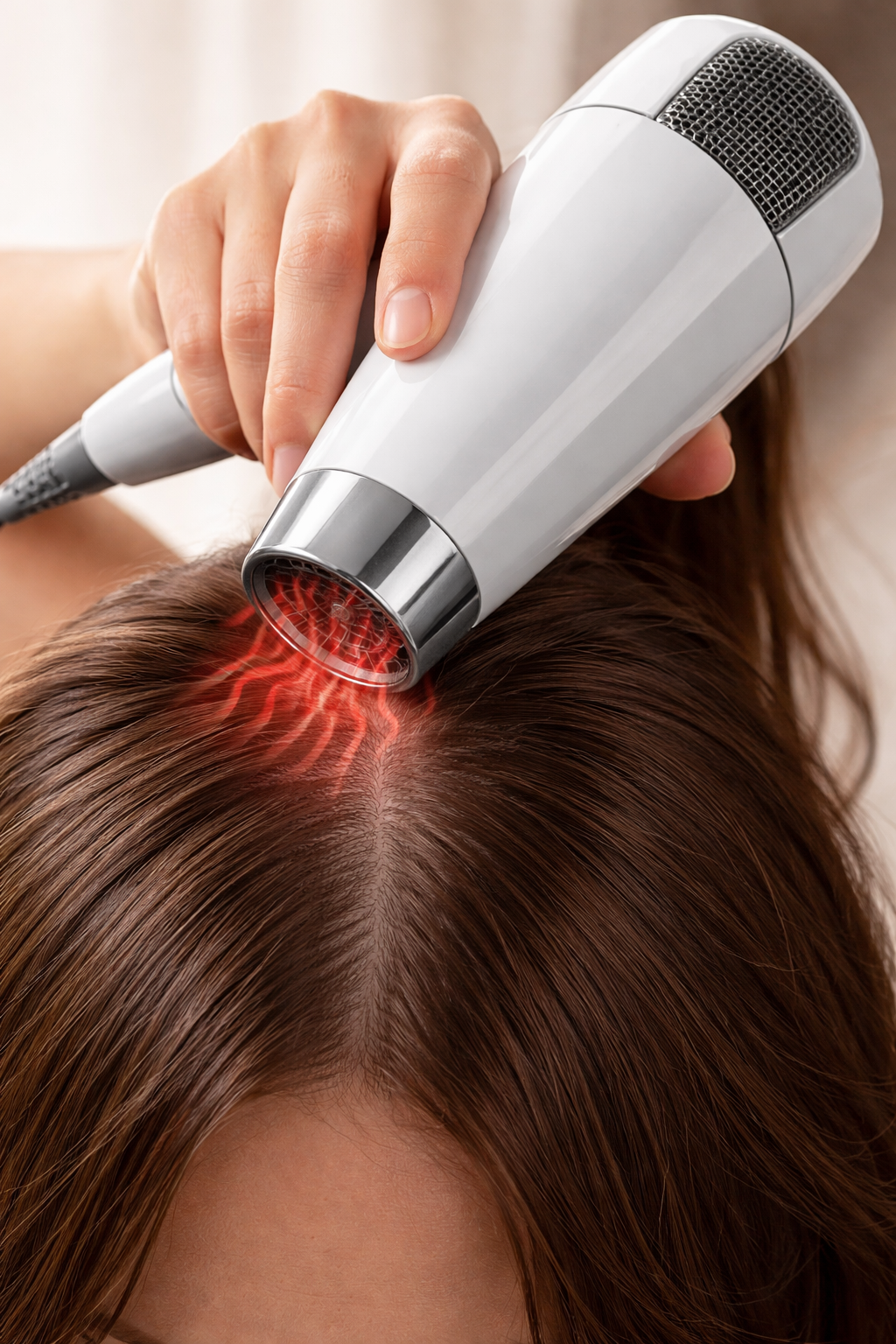
As soon as you keep enough distance between the hair dryer and the scalp to work safely, all effectiveness against lice eggs is immediately lost. Nits are located very close to the scalp, just a few millimeters away. To kill a nit by drying, it must be treated directly with a specific and precise air temperature for 30 seconds. The airflow must also not be blocked by hair.
This is only possible with the patented AirAllé® device.

Combing Treatment
Have you ever heard of the “Lice in your hair? Just comb!” campaign by the R.I.V.M? It states that combing is more effective than using lice treatments. However, even combing with a regular nit comb is only effective in 38% to 57% of cases when done daily for at least two weeks.
This is because nits and nymphs often slip through the comb teeth, and lice move away from the comb. Nits are so small that they frequently pass easily through the gaps between the teeth. It is therefore important to use a nit comb with metal teeth. Even metal teeth, however, can be pushed apart by the hair, allowing nits to slip through.
Lice Clinic Europe uses exclusively a professional-quality nit comb specially developed by and for head lice specialists. The teeth of this comb are uniquely sealed into the handle, preventing them from shifting. This ensures that nits are effectively removed.
Even the specialists at the Lice Clinic Europe cannot remove 100% of nits in a single combing session, but around 99%.
This is not a problem because here an AirAllé® treatment is applied during the clinic session, so all nits are already killed. However, if no AirAllé® treatment has been done beforehand, there is a risk that any nits missed by the comb are still alive, meaning the infestation is not fully eliminated.
Information and instructions for an effective combing method that guarantees the entire lice lifecycle is eliminated in just 4 to 7 combing sessions can be found here: Combing Treatment.

Lice shampoo
There are commercial products and home remedies.
Unless resistance has developed, lice shampoos are usually effective against lice, but regardless of the brand or type, they are not very effective against nits (lice eggs).
The RIVM also states that lice shampoos are only effective in combination with combing using a nit comb.
Because a significant portion of the nits usually survives the lice treatment, new lice will hatch within 7-10 days.
However, some lice shampoos claim to kill nits.
If research shows that a treatment has killed (a small) portion of the nits, the manufacturer is allowed to state on the packaging that "it kills nits," and it is not necessary to specify the percentage that died.
Lice shampoos can be roughly divided into 3 groups:
- Pesticides as the active ingredient
- Dimethicone as the active ingredient
- Home remedies
Pesticides, such as Permethrin, are the least effective.
Not only are lice increasingly becoming resistant to these types of products, meaning that lice do not die from them, but Permethrin is a neurotoxin.
There is much debate about its safety for health.
Dimethicone is a chemical silicone oil that clogs the louse's breathing holes, causing it to suffocate in its own bodily fluids. Resistance is not possible.
By far the most effective of the three types, because it kills all lice (when correctly applied) and kills more nits than the other two types, however, not all.
No known health risks, although it can have a suffocating effect on the scalp and hair, possibly resulting in dry skin, dandruff, and itching.
Home remedies are often used because someone has had success with them by chance, and because these are usually natural, inexpensive, non-commercial products, people are eager to believe in them.
Vinegar, green soap, mayonnaise, eucalyptus oil, tea tree oil, rosemary oil, baby hair lotion, hair dye, alcohol, or the outright dangerous variations such as petroleum, turpentine, or even flea repellents for animals!
Unfortunately, we have to debunk all these myths.
All these methods only have an effect (to some extent) on lice, but hardly any on the eggs.
The lice are the tip of the iceberg, with the eggs making up the vast majority of the metaphorical iceberg beneath the water's surface.
.png)
The belief that a natural remedy can have no side effects is also untrue.
Even an essential oil like Tea Tree can have hormonal side effects in some cases:
“Studies in human cell lines indicated that lavender and tea tree oils have pro-female (estrogenic) and anti-male (antiandrogenic) hormone activities, and researchers found that “repeated topical exposure to lavender and tea tree oils probably caused prepubertal gynecomastia in these boys.” source
More information about Tea Tree oil against head lice can be found in this article.
Cause of chronic infestations
(Commercial) lice treatments are by far the most commonly used method. However, because lice treatments claim to kill the nits, giving the impression of killing "all" nits, when in reality only a portion is killed, many people don't realize that the infestation is not resolved.
We constantly hear from people who didn't comb, or didn't do so for long enough time, because they mistakenly believed that the lice treatment would suffice.
Often, they then turn to numerous other brands with the same result, without implementing an effective two-week combing treatment.
This leads to (very) prolonged infestations, with eventually so many nits that, at some point, they become too extensive for individuals to eliminate without professional help.
The large number of people in the proximity of individuals with prolonged infestations who become infected by them significantly increases the chances of reinfection.
